Saturday, June 27, 2009

The Ship of Theseus Puzzle


CousinoMacul
The Ship of Theseus Puzzle
Identity Over Time

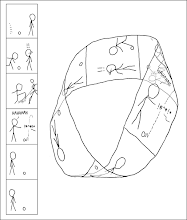
The Ship of Theseus Puzzle. The ancient historian Plutarch recounts the story of the famous ship of Theseus, which was displayed in Athens for many centuries. Over time, the ship's planks wore down and were gradually replaced. In the ancient world, the ship became “a standing example among the philosophers, for the logical question as to things that grow; one side holding that the ship remained the same, and the other contending it was not the same” (Clough 1859, p. 21). In the modern era, the case took on added interest, owing to a twist from Thomas Hobbes. Suppose that a custodian collects the original planks as they are removed from the ship and later puts them back together in the original arrangement. In this version of the story, we are left with two seafaring vessels, one on display in Athens and one in the possession of the custodian. But where is the famous Ship of Theseus? With the museum! After all, ships and other artifacts can survive the complete replacement of parts, provided that the change is sufficiently gradual. With the custodian! After all, ships and other artifacts can survive being disassembled and reassembled. Thus, at the end of the story, the ship of Theseus is present in two places at once. More generally, the argument suggests that it is possible for one material object to exist in two places at the same time. (We get an equally implausible result by working backwards: There are clearly two ships at the end of the story. Each of those ships was also around at the beginning of the story, for the reasons just given. So, at the beginning of the story, there were actually two ships of Theseus occupying the same place at the same time, one of which would go on to the museum and one of which would enter into the care of the custodian.)

Friday, June 05, 2009

Happy Birthday to myself

As I celebrate my own birthday today I would like to pay homage to the courage of the Tiananmen square protester which also happened on this day, twenty years ago.

Are You ProLife? Was Scott Roeder when he killed George Tiller?

Christopher Hitchens - The Morals of an Atheist

Part 1


Part 2

Bart Ehrman on The York Yurks

Check Out The Hidden Contradictions Of The Bible

Guns Don't Kill People - Monkeys With Guns Kill People.

Myth: Global Warming is caused by solar radiation.


http://www.youtube.com/user/DonExodus2

TED Talk - Mary Roach: 10 things you didn't know about orgasm

Friday, May 01, 2009

Year of Darwin - Neil Shubin, Ph.D.


Neil Shubin, Ph.D. University of Chicago
October 14, 2008

Cleveland Museuem of Natural History Professor Shubin (University of Chicago) is a well-known paleontologist who studies the morphological and developmental origins of the tetrapod limb. He recently discovered Tiktaalik, a species linking aquatic "lobe-finned" fishes with early terrestrial tetrapods. Held in conjunction with the Society of Vertebrate Paleontology's annual meeting in downtown Cleveland.

Saturday, January 31, 2009

Stephen Green is a ignorant duplicitous tool and I hope he chokes.


Stephen Green fails again as advertising watchdog raps his knuckles.

An advertisement placed by Stephen Green's Christian Voice organisation in the New Statesman has been condemned as "misleading" by the advertising watchdog.

The advert claimed that the HPV vaccine Gardasil (which aims to prevent cervical cancer) would make teenagers sterile. Mr Green has said frequently that giving the vaccine to young girls will cause them to become sexually promiscuous and lead to a surge in sexually transmitted diseases that lead to infertility.

The ad said: "Now we have the disaster of teenage infertility. Every Government initiative, including the HPV vaccine, will increase it, but as all the targets revolve around pregnancy, no-one in power knows how many young people they are making sterile and nobody cares."

The Advertising Standards Authority found the advert breached codes on truthfulness, substantiation and principles. The ASA said: 'We considered that the [HPV] claim was a statement of fact that was a matter open to substantiation. The advert in New Statesman magazine claimed the cervical cancer vaccine would make teenagers sterile. Because we had not seen robust, scientific evidence that the HPV vaccine caused infertility in teenagers, we concluded that the claim had not been substantiated and was misleading. The ad must not appear again in its current form. We told Christian Voice not to repeat the implied claim that the HPV vaccine would result in teenage infertility."

During the investigation, Stephen Green said: "It is preposterous for the ASA to think they can outlaw Christian freedom of speech."

The advert, headlined "Violent Crime – Sowing And Reaping", also blamed the abolition of the death penalty, divorce and working mothers for the "shocking callousness and brutality in society of which the growing trend of violent deaths of teenagers is the starkest evidence".

Source: National Secular Society e-mail Newsline 30 January 2009

Glenn Beck is a moronic tool.

Seeing and Believing by Jerry A. Coyne

I.

Charles Darwin was born on February 12, 1809--the same day as Abraham Lincoln--and published his magnum opus, On the Origin of Species, fifty years later. Every half century, then, a Darwin Year comes around: an occasion to honor his theory of evolution by natural selection, which is surely the most important concept in biology, and perhaps the most revolutionary scientific idea in history. 2009 is such a year, and we biologists are preparing to fan out across the land, giving talks and attending a multitude of DarwinFests. The melancholy part is that we will be speaking more to other scientists than to the American public. For in this country, Darwin is a man of low repute. The ideas that made Darwin's theory so revolutionary are precisely the ones that repel much of religious America, for they imply that, far from having a divinely scripted role in the drama of life, our species is the accidental and contingent result of a purely natural process.

Read the rest of this article here Seeing and Believing by

Sunday, November 02, 2008

What's the harm?


What is this site?

We are all confronted with new information daily. It comes to us via newspapers, radio, television, websites, conversation, advertising and so on. Sometimes it seems like a deluge.

Not all information is created equal. Some of it is correct. Some of it is incorrect. Some of it is carefully balanced. Some of it is heavily biased. Some of it is just plain crazy.

It is vital in the midst of this deluge that each of us be able to sort through all of this, keeping the useful information and discarding the rest. This requires the skill of critical thinking. Unfortunately, this is a skill that is often neglected in schools.....

http://whatstheharm.net/

Stop Sylvia Browne

Stop Sylvia Browne

http://www.stopsylvia.com/home/

Psychic tries to stop Stop Sylvia Browne

skeptics-load-your-google-bombs

What's the harm?

Thursday, September 11, 2008

Bad Science


Ben Goldacre seen here recently on The One Show, talks about Bad Science.

www.badscience.net is his website and Bad Science is his new book.

Wednesday, July 16, 2008

Why?

As biologically and culturally evolved beings, humans seem to have certain epistemological proclivities. Perhaps asking "why questions" is one of these proclivities. Perhaps sometimes asking "why questions" is nonsensical. Tantamount to asking for a square circle.

I was thinking about infinite regression of explanations. People always end up asking why instead of how. What makes us think there is a why? The human search for meaning? Perhaps there is ultimately none. This might be the case even if it is unsatisfactory.

The search continues.

Monday, June 30, 2008

Philosopher 1 - 0 Abraham

And the Lord spake unto the philosopher, 'I am the Lord thy God, and I command thee to sacrifice thy only son.'

The philosopher replied, 'There's something not right here. Your commandments say, "Thou shalt not kill".'

'The Lord giveth the rules and the Lord taketh away.' replied God.

'But how do I know you are God?' insisted the philosopher. 'Perhaps you are the devil trying to fool me?'

'You must have faith,' replied God

'Faith - or insanity? Perhaps my mind is playing ricks? Or maybe you're testing me in a cunning way. You want to see if I have so little moral fibre that at the command of a deep voice booming through the clouds, I commit infanticide.'

'Me almighty!' exclaimed the Lord. 'What you're saying is that it is reasonable for you, a mere mortal, to refuse to do what I, thy Lord God, commands'

'I guess so,' said the philosopher,'and you've given me no good reason to change my mind.'

Fear and Trembling by Søren Kierkegaard (1843)

I think we can agree. The Philosopher 1, Abraham 0.